
To begin with → What is Integrated Active Information?

The natural area for information synthesis is our human intellect, that is, biological memory.
Compared with mechanical memory, our brains have several limitations.
The data we spontaneously accumulate in them are incomplete, and as time passes, some of them are forgotten or distorted.
The main advantage of the human brain is its innate ability to learn, thanks to which it forms a unique awareness of the reality around us.
Integrated Active Information is a support for our human memory, that is, a complete and up-to-date database, because it forgets nothing that is needed, and collects and logically organizes—by imitating the human intellect—all available information on a designated topic.
Can a network of links between internet-based pieces of information reflect the logical connections between pieces of information in our memory?
I will explain this using the example of the issue I analyzed while creating the model of Integrated Information, namely loans indexed to a foreign currency.
Each of us, when forming an opinion on a given topic, answers the questions that arise on the basis of the data stored in memory and on the basis of calculations and analyses that one has read or carried out personally. Even if the available data are very limited, our mind is able to form a >view< on their basis, because it replaces missing data with guesses. Of course, without the proper data, our judgment may diverge from reality, and so, for example, we may claim that the Earth is not a sphere but flat.
In simplified terms, one may say that a change of view requires the addition of new data (analyses, calculations) to our database, which replace guesses and make it possible to draw new conclusions.

Unfortunately, our minds synthesize such different and often unreliable information that we may perceive the phenomena around us in completely different ways. The differences may be so large that even two people may be unable to reach an understanding, and the situation becomes far more complicated when a group as large as a nation or many nations is supposed to reach agreement. At present, the shape of the Earth hardly arouses controversy, but reaching agreement on global warming or pseudo-currency loans is already a major challenge for society.
Perhaps the situation will change when we create a communicative space that takes into account all possible points of view and organizes all the necessary data on the subject on which we want to reach agreement.
At present, all existing media provide only fragmentary information about Complex Issues, and the synthesis of that information is performed individually by each person’s brain. Unfortunately, many important pieces of information do not reach us or are forgotten, which is why our conclusions are often based on guesses and opinions rather than on facts.
An Active Internet Information Structure concerning a Complex Issue is meant to create a space for synthesizing the data necessary to solve a specific problem. It is intended to provide a complete set of up-to-date information connected within a logical network of links, that is, already prepared for synthesis.
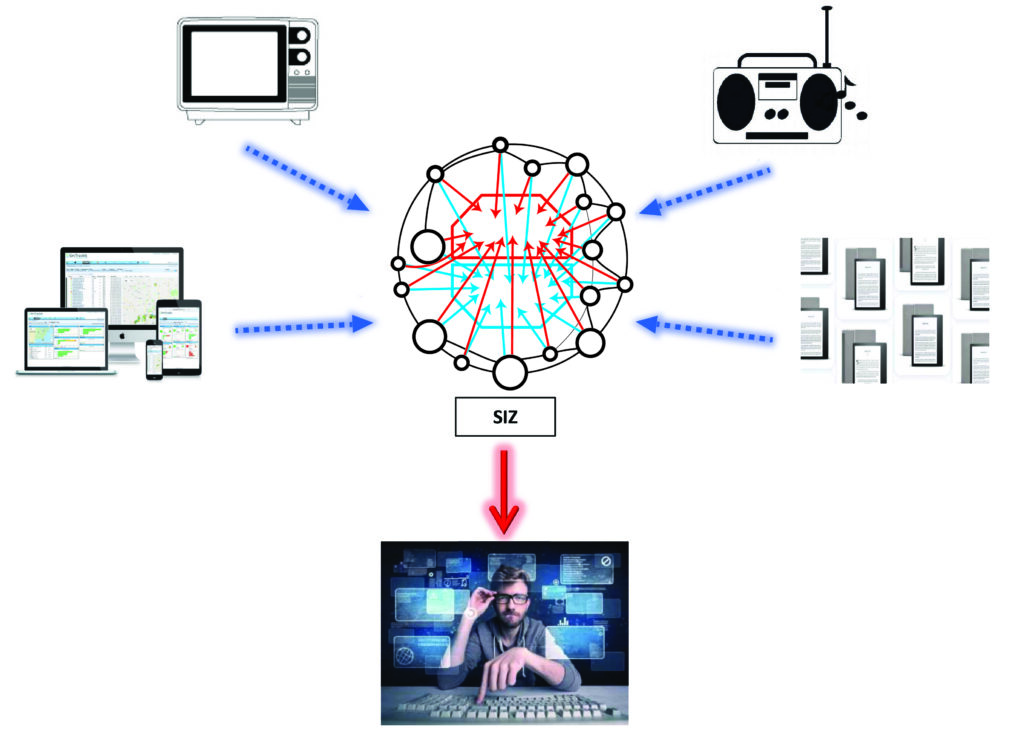
The logical information structure created in this way will reflect the process of problem analysis taking place in the human mind, but the database of that structure will be defined through the study of collective consciousness (through big-data analysis of mass-media materials) and will contain all the necessary facts (the full body of current knowledge) needed for rational inference.
What distinguishes Integrated Active Information from other kinds of information?
Integrated Active Information can reach a larger audience than a one-time newspaper article or a television or radio program. A comprehensive and long-term treatment of a problem allows for deeper analysis, and individual conclusions can be drawn on the basis of a broad field of vision and a complete database.
A UNIQUE INFORMATION STRUCTURE
Unlike all other means of communication – television, radio, books, newspapers – IAI does not merely deliver a one-time piece of information that will be out of date tomorrow, but has an active structure in which partial pieces of information may change every day.
Its database evolves through the addition of new data or new points of view, and therefore remains continuously up to date.
When creating Integrated Information, we define from the very beginning the entire potential area of the issue and deepen it every day, thanks to which we always have access to a comprehensive discussion of the issue rather than just a small fragment of it. The process of creating this information structure is not limited by a publication or broadcast deadline, and therefore may continue uninterrupted even for many years, while recipients of the information will be able to systematically check what has changed in the perception of the analyzed problem.
AN INTERDISCIPLINARY TEAM OF SPECIALISTS
My project is a proposal to support the natural mechanism → unconscious, individual,
spontaneous, accidental collection of information about complicated problems (the mechanism according to which every human intellect operates) with an additional mechanism → conscious, collective, professionalized creation of databases.
Every analyst joining this interdisciplinary team will be guided by the same idea—the collection of data necessary to explain the problem. While working on Integrated Information, scholars will work together on the whole analysis, rather than merely producing separate studies from the perspective of a single academic discipline.
Because in the case of IAI the time spent editing information never ends, the consideration of the problem may take place live, within a logical internet structure.
FIRST A FULL ANALYSIS, AND THEN THE FOUNDATIONS OF SYNTHESIS
First, all points of view regarding the described problem are taken into account, which is intended to lead to its full analysis.
Second, Integrated Information gathers in one place a complete information base, that is, all the data, calculations, observations and reflections we need on a given subject; therefore it is a treatment of the issue without any missing logical links, the absence of which forces us to indulge in guesswork.
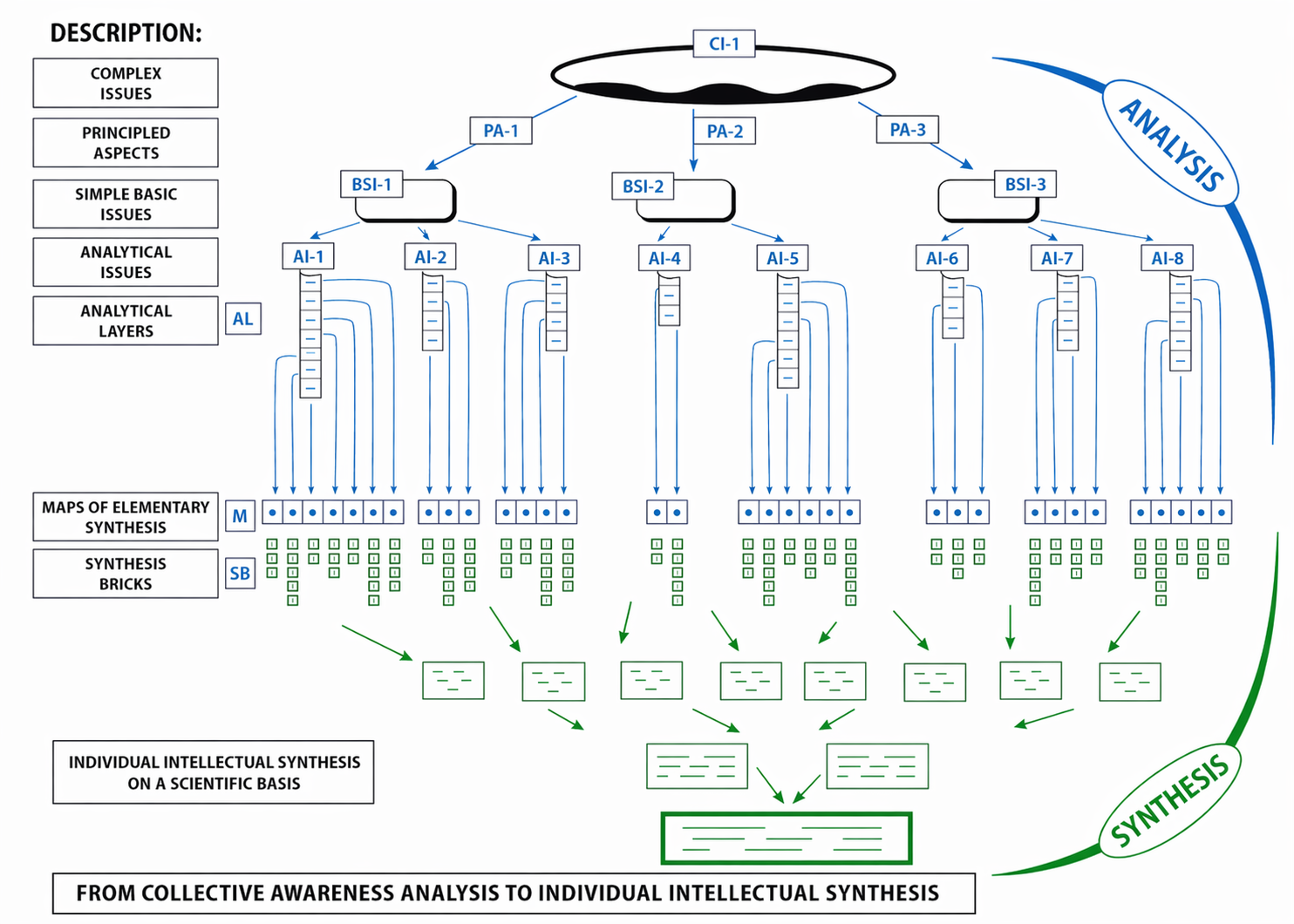
Third, Integrated Information connects by links the information necessary for understanding the individual matters contained within the Complex Issue [Synthesis Bricks], and this means that the data will be arranged in a clear structure.
Its contents—thanks to links connecting materials from the mass media with the scientific base—will also allow for rapid orientation as to which voices in public discourse are credible and which are not. The time required to explore a complex problem will amount to only a few percent of the time it would take to work through it alone.
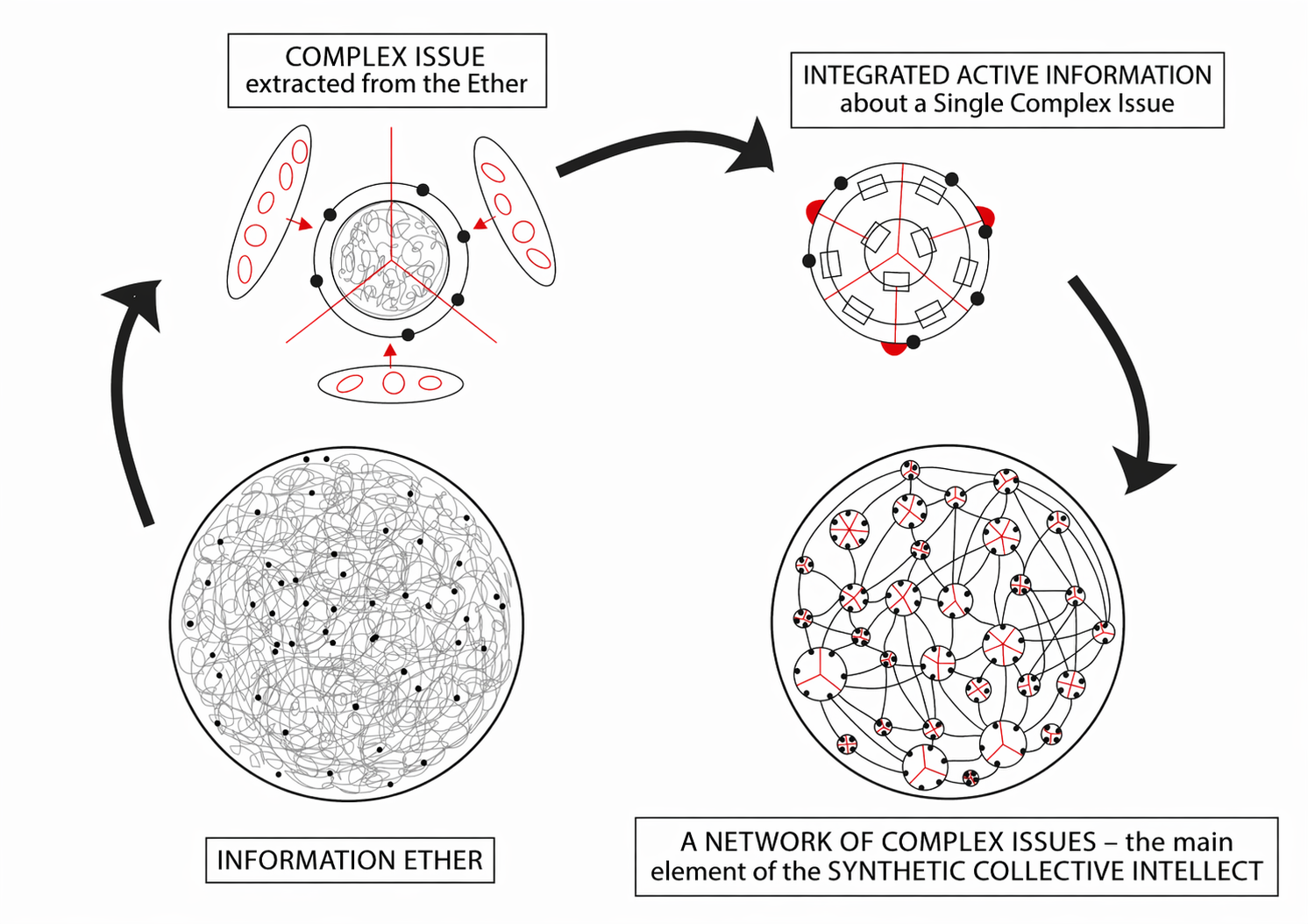
Even Integrated Information concerning a single Complex Issue may enrich collective consciousness with up-to-date knowledge drawn from many scientific disciplines connected with the problem being described. A multiplicity of Integrated Information items creates an entirely new quality. In this way, a → Synthetic Collective Intellect may arise.
A bit of theory → a description of the structure of Integrated Active Information
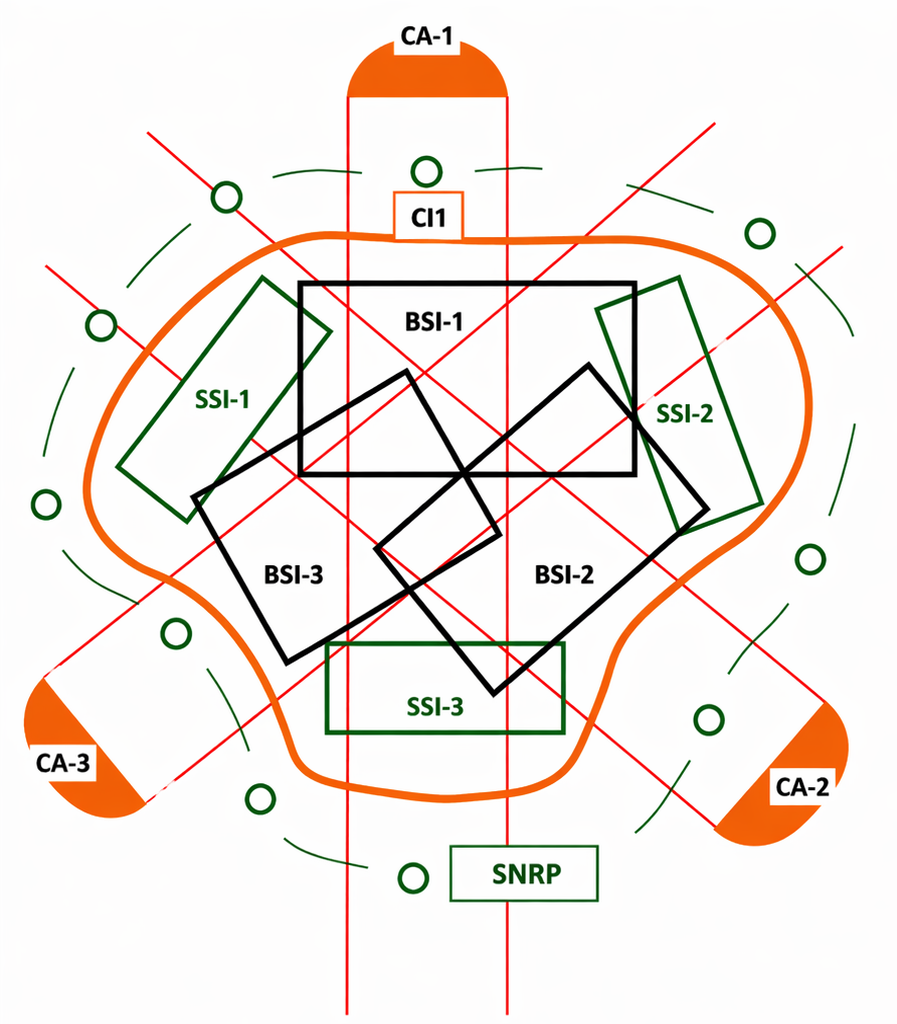
CI1 – the area of Complex Issue number 1 developed by me as an example
CA-1,2,3 – the three Core Aspects for this issue
BSI-1,2,3 – the three Basic Simple Issues that arise at the very beginning of creating IAI
SSI-1,2,3 – the Supplementary Simple Issues that will arise if the Basic Simple Issues do not exhaust the treatment of the topic
SNRP – the System of Necessary Reference Points, which shows the perspectives from which society perceives the issue and therefore defines its area
Explanation: The above diagram and all the examples below concern the issue of two-currency loans (CI1), which is discussed in the example (in the next tab).
COMPLEX ISSUE
– an issue involving an extensive, multidimensional problem, which can be perceived from many scientific aspects as well as from reference points existing in social consciousness;
in order to organize it, Integrated Information divides the Complex Issue into smaller elements → Simple Issues, which in turn divide into smaller ones;
example of a Complex Issue → CI-1:
Two-currency loans, that is, loans indexed, valorized or denominated to a foreign currency.
BASIC SIMPLE ISSUES
– when creating IAI, we first determine the Core Aspects of a given issue – for example, in the case of two-currency loans I distinguished the following three aspects:
PROTECTION-RESPONSIBILITY-PROFIT, therefore in the case of this subject three Basic Issues should be drafted;
each Basic Issue touches all three of these aspects, but one of them is clearly dominant within it;
{more on this in the “two-currency loans” tab – Three Core Aspects}
example of Basic Simple Issue no. 1 → BSI-1:
When is a loan agreement invalid?
[Core Aspect → Responsibility]
SUPPLEMENTARY SIMPLE ISSUES
– drafting the Basic Issues does not always cover all matters important to the topic, therefore, when creating IAI, besides the Core Aspects we also determine the System of Necessary Reference Points, that is, the perspectives from which, as a society, we perceive the problem under discussion; this allows one to determine what other issues should still be developed in order to exhaust the topic – these are the Supplementary Simple Issues;
this time without an example – Supplementary Issues can be planned only after an exhaustive development of the Basic Issues
{more on this in the “two-currency loans” tab – SNRP}
ANALYTICAL ISSUES
– although Simple Issues – both Basic and Supplementary – cover only part of the area of the Complex Issue, they are still structures too extensive for their analysis to be presented all at once as a single whole, so we divide them into smaller elements
→ Analytical Issues;
example → AI-1 [element →BSI-1]:
Analysis of the content of a two-currency loan agreement (valorized or indexed to a foreign currency)
ANALYTICAL LAYERS
– depending on the degree of complexity, an Analytical Issue may be single-part, in other words single-layered, or it may consist of many layers, that is, many sub-points; each layer leads us to the answer to one elementary question related to the analyzed problem;
example of an analytical layer → AL-8 [element →AI-1→BSI-1]:
Is the structure of a two-currency loan agreement too complicated, and can such an agreement be understood by an average borrower?
MAP AND SYNTHESIS BRICKS
– each analytical layer leads us to certain conclusions, but Integrated Information, besides answers to Elementary Questions, also shows the Synthesis Bricks and the Synthesis Map, that is, the data that lead us to specific conclusions.
example of an elementary synthesis-brick map → M8 (AB-15, SB-04, SB-02) [→AL-8 →AI-1→BSI-1]:
three bricks contribute to the conclusions regarding the structure of a two-currency loan agreement:
AB-15 → comparison of the analysis of decision-making processes carried out on the basis of a single-currency loan agreement and a two-currency loan agreement;
SB-04 → observation from psychology – the limits of understanding complex information by the average person;
SB-02 → EU regulations – when loan-agreement clauses are not binding on the consumer;
→ The three studies mentioned above form the foundation of synthesis, that is, they make it possible to answer the question:
were two-currency loan agreements understandable to the average consumer, and were they therefore binding on that consumer?
* Full name: Active Internet Interdisciplinary Integrated Information Structure concerning a Complex Issue *
Active Internet – by this expression I mean a set of information that can exist only on the Internet, because only in such an environment can it be expanded and updated without any limitations
Complex Issue – a team of analysts (while creating algorithms for searching large databases) filters thousands of news items in the mass media concerning a complex problem in order to determine what is important to each of us, and therefore to encompass the entire area of the issue under discussion
Interdisciplinary – teams led by scholars from different disciplines – for example law, economics, psychology, etc. – develop all the matters concerning the analyzed complex issue and arrange them into a logical whole
Integrated Information Structure – source information from the mass media, that is, press articles, radio statements or television statements, are connected by links with the analytical and scientific base, thus creating an Integrated Structure.
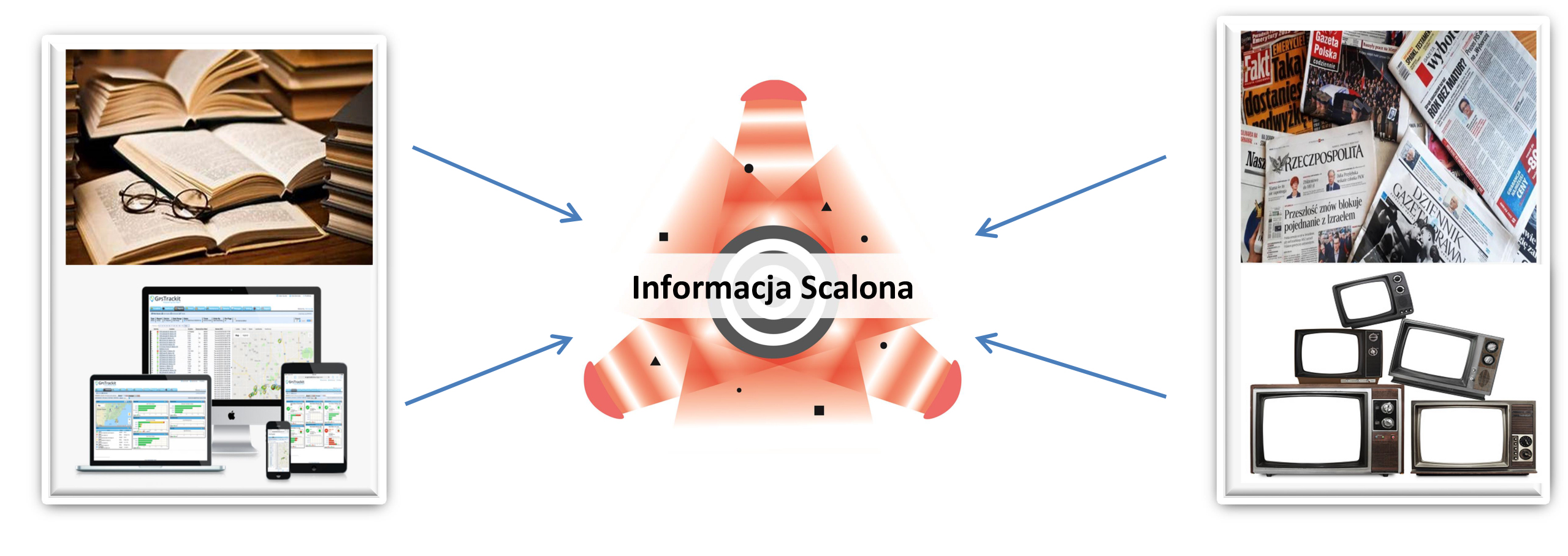
Active Internet Interdisciplinary Integrated Information Structure → definitions, statistical data, extracts from legal regulations and principles of economics, time-consuming calculations, specialist analyses, that is, a body of knowledge that no individual human being is capable of gathering alone, while the pieces of information that make it up are collected and clearly connected in a synthetic structure by a network of links, which enables every interested person to dig into the problem all the way to the end.